

A robust AEM architecture is the backbone of any successful digital experience platform. It ensures your website is fast and reliable today and ready to grow and adapt tomorrow.
A well-designed AEM architecture is critical for scalability, maintainability, and performance. Without a solid foundation, even the most innovative digital strategies can fail.
This blog will explore the essential strategies and AEM design patterns needed to build a resilient and scalable Adobe Experience Manager solution. It will cover everything from core fundamentals to cloud-native deployments and advanced integration patterns.
Understanding Adobe Experience Manager Architecture Fundamentals
At its heart, Adobe Experience Manager (AEM) is a powerful, content-centric platform. Its architecture is built on core technologies that work together to manage, create, and deliver content. Understanding these fundamentals is key to building an effective AEM implementation.

AEM Build Blocks: Modular OSGi Framework, Sling, and JCR
AEM’s core components are the Open Services Gateway Initiative (OSGi), Apache Sling, and the Java Content Repository (JCR). These technologies form the foundation of the entire system.
OSGi Framework
This is a dynamic, modular framework for building Java applications. It allows developers to create small, reusable modules, known as bundles, that can be started, stopped, and updated independently.
This modularity is a key feature of AEM’s architecture. It enables AEM to be highly extensible and maintainable. It’s a critical part of how AEM manages its services and dependencies.
Apache Sling
This is a web-based interface, a RESTful web framework. It’s “content-centric” because it maps incoming requests directly to a resource in the content repository. It then identifies the correct script to render that resource based on the URL.
This simple but powerful approach makes delivering web pages and other digital content easy. It’s the engine that handles incoming requests and provides the rendering logic.
Java Content Repository (JCR)
The Java Content Repository, or JCR, is a hierarchical database for storing unstructured and semi-structured data. AEM uses Apache Jackrabbit Oak as its JCR implementation. It stores all content, code, configurations, and user data.
The JCR’s tree-like structure makes content easy to organize and access. It’s where all the published content and authoring data reside.
Switch from AEM to WordPress for More Flexibility and Lower Costs
Get expert AEM to WordPress migration with Seahawk’s proven process, ensuring data integrity, SEO preservation, and a user-friendly interface.
Content Repository and Performance: Caching, Scalability, and High Availability
Optimizing the content repository and ensuring high performance are critical for a great user experience. AEM provides several mechanisms to achieve this.
Caching
AEM uses multiple caching layers to improve performance. The Dispatcher is the first line of defense. It’s a web server extension that caches static HTML pages and assets. It serves these cached files to end users, reducing the load on the AEM publish instance. This makes efficient content delivery possible.
AEM also has a query cache and other internal caching mechanisms to speed up content access. A well-configured dispatcher is vital for any AEM implementation.
Clustering and Load Balancing
AEM environments are often deployed with multiple publish instances to handle traffic spikes and ensure high availability. This setup is called a publish tier.
A load balancer distributes incoming requests across these instances, preventing a single server from becoming a bottleneck and providing redundancy. If one publish instance fails, the load balancer reroutes traffic to the others, ensuring the site remains available.
High Availability
This is achieved by combining clustering and load balancing to minimize downtime. The author instance is also often clustered, providing a failover mechanism for content authors. In a robust setup, there is no single point of failure.
AEM Deployment Patterns: On-Prem vs Cloud-Native Architectures
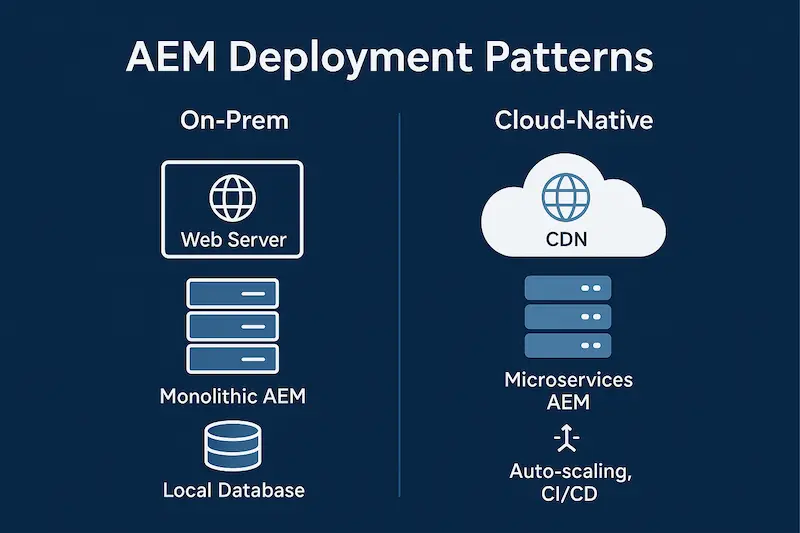
Choosing the right deployment model is a foundational decision for any project. There are two primary AEM deployment patterns: traditional on-premise and modern cloud-native.
Transitioning to AEM as a Cloud Service (AEMaaCS)
AEM as a Cloud Service (AEMaaCS) represents a significant shift from the traditional on-premise model. It’s a cloud-native platform that fundamentally changes how Adobe Experience Manager is deployed and managed.
- Microservices and Containerization: AEM as a Cloud Service breaks down AEM into smaller, independent services that run in containers. This microservices-based approach allows for dynamic scaling and ensures that the AEM environment can handle traffic spikes automatically.
- CI/CD Pipelines and Automatic Updates: The platform uses continuous integration and continuous delivery (CI/CD), which is managed through Cloud Manager. Cloud Manager automates the deployment process for application code and ensures that all instances are always on the latest version. This includes daily maintenance and monthly feature updates. These automation capabilities streamline feature development and deployment.
- Dynamic Scaling and Rolling Updates: AEM as a Cloud Service scales dynamically. It automatically adds or removes multiple publish instances based on actual traffic. This dynamic scaling is a huge advantage. It also uses a rolling update pattern. This means that code changes and updates happen with zero downtime.
Also Read: Cloud Digital Asset Management
Challenges and Trade-offs in AEM Cloud Implementations
While AEM as a Cloud Service offers many benefits, it also presents a new set of considerations.
- Security Considerations: Security is a shared responsibility. While Adobe manages the underlying infrastructure, organizations are responsible for securing their custom code and integrations. Proper access control and adhering to security best practices are essential.
- Learning Curve: The cloud-native model introduces new concepts like Cloud Manager, continuous integration, and continuous delivery. Developers and architects need to adapt to this new paradigm. The local development environment is a core part of this.
- Limited Customization vs. Control: AEMaaCS is a managed service. This means less direct access to the underlying servers and file systems. It provides less flexibility than on-premise solutions. For example, there’s a specific way to create custom components and deploy code. This requires a shift in thinking from traditional AEM development.
Integration Architecture: API-First and Generic Framework Approaches
Modern digital experiences rarely exist in a silo. They must integrate with third-party systems like CRMs, e-commerce platforms, and other services. An innovative integration architecture is crucial.
Building a Reusable Generic API Framework in AEM
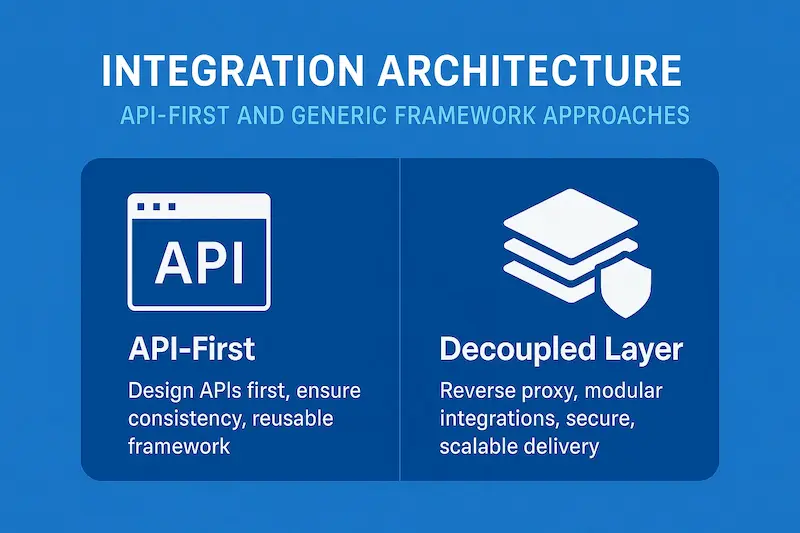
An API-first design approach is a powerful strategy for AEM integrations. It means designing and developing the APIs that will be used for integrations first.
- Benefits: A reusable generic API framework offers many advantages. It ensures consistency across integrations, improves maintainability because logic is centralized, and enhances scalability. This approach allows other systems to consume content and data easily and creates a contract for how AEM will exchange data.
- Implementation: This framework can be built using Sling Servlets or Sling Models with Sling Model Exporters. This allows developers to create standardized JSON endpoints that deliver content to different applications. It’s a great way to enable headless AEM.
Leveraging Reverse Proxies and Decoupled API Layers
Decoupling the API layer from the AEM author and publish instances provides flexibility and security.
- Reverse Proxies: A reverse proxy (like the AEM Dispatcher or a CDN) can sit in front of the AEM environment. It can route API traffic to different services or even different AEM instances. This provides a layer of abstraction. It allows for modular integrations. For example, a content delivery network (CDN) can use origin selectors to route requests for a specific API to a separate, dedicated integration layer. This keeps the publish tiers focused on serving web pages to end users.
- Decoupled Design: A decoupled approach means that the front-end application (e.g., a React or Angular app) consumes JSON from AEM APIs. This allows for an experience-led architecture. The front-end team can work independently of the AEM back-end team. AEM becomes a content hub. This pattern is ideal for AEM Edge Delivery Services and other modern front-end frameworks.
Design Patterns to Strengthen AEM Architecture
AEM design patterns are reusable solutions to common problems in software development. Using them helps create a more robust and maintainable AEM architecture.
Essential Patterns: MVC (Model-Component-View), Singleton, Factory, Observer
These are some of the most fundamental AEM design patterns. They manage code structure and object creation.
- MVC (Model-Component-View): This pattern separates concerns within a component. The Model represents the business logic and data. The View is the presentation layer, typically an HTML Template Language (HTL) file. The Component ties the model and view together. This separation makes components easier to maintain and test. It’s a core pattern for all custom components.
- Singleton: This pattern ensures that a class has only one instance and provides a global point of access to it. In AEM, OSGi services are singletons by nature. This means a single service instance is used across the entire AEM application. It’s useful for services like a configuration reader or a connection manager.
- Factory: This pattern creates objects without specifying the exact class. It helps create different types of components based on certain conditions. For example, a factory could make a specific component for a particular type of content.
- Observer: This pattern defines a one-to-many dependency between objects. When one object’s state changes, all its dependents are notified automatically. AEM’s event handling system and custom workflows are based on this pattern. For example, a workflow can be triggered when a new page is published.
Structural Patterns: Composite, Decorator, Adapter, Strategy in AEM Components
These patterns help to structure components and their relationships.
- Composite: This pattern allows you to treat individual objects and compositions of objects uniformly. AEM components are naturally composite. A page is a composite of components. A component can be a composite of other elements. This allows for robust and flexible content structures.
- Decorator: This pattern adds new responsibilities to an object dynamically. In AEM, you can use decorators to enhance a component’s functionality at runtime without changing its core code. For example, you could wrap a standard text component with a decorator to add a specific styling class based on a user’s role.
- Adapter: This pattern lets two incompatible interfaces work together. Sling’s adaptTo() mechanism is an excellent example of this. It allows you to adapt a resource or a request to another object type, such as a Sling Model. This is a crucial part of AEM’s architecture for building flexible components.
- Strategy: This pattern enables an algorithm’s behavior to be selected at runtime. You can use it to choose a different rendering strategy for a component based on context. For instance, a component could have different rendering strategies for mobile and desktop views.
AEM Content Strategy and Best Practices for Robust Architecture
A great AEM architecture is not just about code. It’s also about content. A smart content strategy is essential for long-term success.
Laying the Foundation: Clear Goals, Content Architecture, Team Alignment
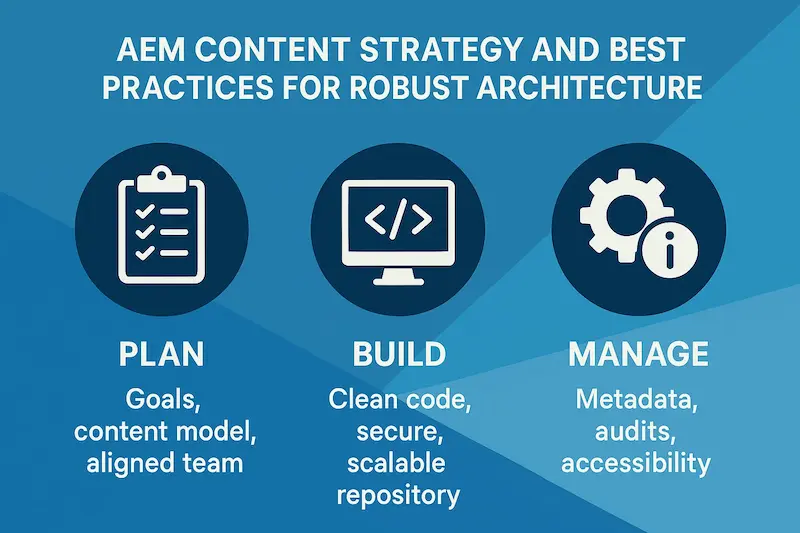
Start with a clear plan. A robust AEM implementation needs a solid foundation.
- Defined Business Objectives: What are you trying to achieve? What are your key performance indicators? These questions must be answered before a single line of code is written.
- Structured Content Model: A well-structured content architecture is paramount. It ensures consistency, reusable content, and ease of management. Content Fragments and Experience Fragments are key tools for this. A clear content model streamlines the content creation process.
- Team Alignment: Roles and responsibilities must be clear. This includes content authors, developers, and project managers. Everyone must understand the project goals and how they fit into the bigger picture.
Coding and Repository Guidelines: JCR, OSGi, Sling Models vs WCMUse, Java API
Follow best practices for code and repository management. This ensures a healthy, performant, and secure AEM application.
- Organized Code: Use a consistent coding style and project structure. This makes code easier to read and maintain.
- Sling Models vs. WCMUse: Use Sling Models for new development. They provide a clear, annotation-driven way to adapt resources to Java objects, much better than the deprecated WCMUse API. It’s a core principle of modern Adobe Experience Manager development.
- JCR Session Management: Open and close JCR sessions correctly. A good rule of thumb is “one session per request.” This prevents resource leaks and performance degradation.
- Security: Sanitize all user input to prevent vulnerabilities like cross-site scripting. Use secure access control lists to manage user permissions.
Deployment and Oak Repository Optimization
The health of the Oak repository is critical. It must be managed carefully.
- Horizontal vs. Vertical Scaling: Horizontal scaling means adding more servers to the publish tier to handle load. This is the preferred method for scaling AEM environments. Vertical scaling means upgrading the resources of a single server. AEMaaCS handles horizontal scaling automatically.
- Choosing a NodeStore: The NodeStore is the persistence layer of the Oak repository. The correct choice depends on your needs. Adobe manages AEM as a cloud service for you.
- Online Revision Cleanup: Oak generates new revisions for every change, which can lead to repository growth. AEM has an online revision cleanup process to remove old, unreferenced revisions, keeping the repository healthy and performant.
Asset & Sites Management: Naming, Metadata, Auditing, Accessibility
Good content and asset management practices are vital. They ensure a consistent and compliant user experience.
- Consistent Naming: Use clear, consistent naming conventions for assets and pages. This makes them easy to find and manage.
- Metadata: Use metadata to add context to assets. This helps with searchability and discoverability and is crucial for efficient content delivery.
- Content Audits: Regularly audit your content and assets. This helps you identify and archive outdated or unused items.
- Accessibility (WCAG): Ensure all content and components are accessible to users with disabilities. Adhere to Web Content Accessibility Guidelines (WCAG) standards. This is not just a best practice; it’s a legal requirement in many regions.
Advanced Integrations and Rendering Patterns in AEM
The evolution of AEM has brought new, powerful rendering patterns. These patterns allow AEM to be more flexible and integrate with modern front-end technologies.
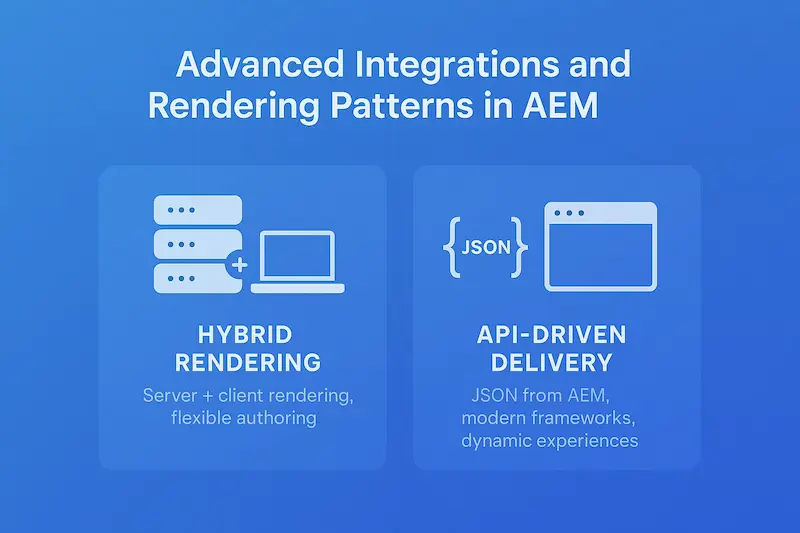
Experience-Led Architecture for Hybrid Rendering and API-Driven Delivery
This pattern combines the strengths of AEM’s traditional rendering with a headless approach. It’s a hybrid model for delivering modern digital experiences.
- Hybrid Rendering: AEM can handle server-side rendering (HTL) and client-side rendering (frameworks like React or Angular). In this pattern, AEM provides a foundation for authoring and content assembly.
- API-Driven Delivery: The front-end application consumes JSON payloads from AEM, which Sling Model Exporters enable. The front-end then renders the content on the client side. This approach is perfect for highly dynamic web pages and single-page applications.
Summary of Best Practices: Ensuring Robustness and Agility in AEM Architecture
A robust AEM architecture is the result of many strategic decisions. Here is a quick recap of the key takeaways.
- Modular OSGi and Sling Usage: Embrace AEM’s modular nature. Use OSGi services for business logic. Use Sling to deliver content in a RESTful manner.
- Cloud-Native Deployment vs. On-Prem Trade-offs: Choose your deployment model wisely. AEM as a Cloud Service offers significant benefits in scalability and maintenance, but it requires a new mindset. On-premises provides more control but demands more operational effort.
- Reusable API Frameworks and Decoupled Design: Build a strong, reusable API layer and decouple your front-end from AEM. This allows for greater flexibility.
- Use of Design Patterns for Maintainability: Apply AEM design patterns to create a clean, maintainable codebase. This is crucial for extensive customization.
- Strategic Content and Asset Structure: Plan your content model before you start building. Use consistent naming and metadata.
- Deployment Tuning and Repository Health: Monitor your repository health, optimize your deployment for performance, and use horizontal scaling.
- Forward-thinking Rendering Patterns: Consider hybrid and headless AEM approaches for modern digital experiences. This allows you to leverage the full power of modern front-end frameworks.
Future Outlook: The Evolution of AEM Architecture
The future of AEM architecture is dynamic and exciting. Adobe is continuously innovating, so we can expect to see AEM evolve even further.
Embracing AI, Edge Delivery, and Cloud-Native Innovation
The platform is moving towards more intelligent and automated systems.
- AI-enabled Personalization: AI and machine learning will play a bigger role in content personalization. AEM is already integrating with Adobe Sensei to achieve these capabilities.
- Edge Delivery Services: AEM Edge Delivery Services brings content closer to the end users. It leverages a CDN for fast, serverless content delivery. This reduces latency and improves performance.
- Serverless Technology and Automated Scaling: The move to serverless technology is ongoing. It will enable even more automated and efficient resource management, further reducing organizations’ operational burden.
Conclusion
Designing a robust and scalable AEM architecture is a complex but rewarding task. It requires a deep understanding of the platform’s fundamentals and a strategic approach to deployment, integration, and code design.
Leveraging the principles of modularity, cloud-native patterns, and proven AEM design patterns can help you build a resilient platform. This platform will not only meet your current needs but also scale to handle the challenges of tomorrow.
Continually architect with maintainability, scalability, and resilience in mind. Whether you choose an on-premise or cloud service model, a strong foundation is the key to delivering exceptional digital experiences.
FAQs About AEM Architecture
How does automated testing improve AEM performance optimization?
Automated testing in AEM helps identify issues early in the development cycle. It optimizes performance by validating workflows, templates, and integrations before deployment. It reduces downtime and improves scalability for delivering content efficiently.
What is the role of the author tier and preview tier in AEM content management?
The author tier is where content authors create, edit, and manage site pages using AEM’s user-friendly interface. The preview tier allows stakeholders to review finished site content before it is published, ensuring quality and consistency in the final delivery.
How can AEM manage previous versions and document-based authoring?
AEM’s content repository supports versioning, enabling teams to roll back to previous versions of pages or assets. Document-based authoring simplifies collaboration by allowing multiple users to work on the same content structure without overwriting each other’s work.
Why are log files and security patches important in AEM architecture?
Log files help track system behavior, detect errors, and support troubleshooting. Regular security patches protect against vulnerabilities, ensuring safe content management and reliable publishing processes.
What is the subscription pattern for publishing content in AEM?
The subscription pattern allows systems or external applications to receive updates automatically when new content is published. This ensures real-time content delivery to all integrated channels and enhances the efficiency of omnichannel publishing strategies.