
Every business reaches a point where someone needs to own the website. Pages break, updates pile up, new features need building, and suddenly you are paying freelancers for every small fix or waiting weeks for an agency to squeeze you into their schedule. At that point, hiring an in-house developer becomes the obvious solution.
But is it actually the right move for your business? In 2026, the average annual salary for a web developer in the United States sits in the low to mid $90,000s, with total compensation including bonuses and equity often pushing past $110,000. Add benefits, tools, hardware, and onboarding time, and the real cost climbs significantly higher than most business owners expect before signing an offer letter.
This guide breaks down exactly what hiring an in-house web developer actually costs, what you gain, what you give up, and what your alternatives look like so you can make a decision that fits your business, not just someone else’s checklist.
It depends on the size, nature, and volume of your web development needs. Here is a quick breakdown to help you decide.
Hire in-house if your business relies heavily on your website for daily operations, you have consistent ongoing development work, and you have the budget to cover salary, benefits, tools, and training.
Hire a freelancer if you have a short-term project, a one-time build, or occasional updates that do not justify a full-time salary.
Work with an agency if you need a full team with diverse skills, fast turnaround, scalability, and access to specialists across frontend, backend, SEO, and design without managing individual hires.
Consider a hybrid model if you want an internal point of contact for daily tasks while outsourcing larger projects or specialized work to an external partner.
There is no single right answer. The best choice matches your workload, budget, and long-term growth plans.
What Does an In-House Web Developer Actually Do?
Before you post a job listing, it helps to be clear about what you are actually hiring for. An in-house web developer is a full-time employee responsible for designing, building, maintaining, and updating your company’s website or web applications. Unlike a freelancer who jumps between clients or an agency team that manages dozens of accounts, an in-house developer works exclusively for your organization.
Their day-to-day responsibilities typically include:
- Building and updating web pages, landing pages, and new site features
- Fixing bugs, resolving downtime issues, and handling technical errors
- Maintaining website security, running updates, and monitoring performance
- Collaborating with marketing, sales, and design teams on new campaigns
- Optimizing site speed, code quality, and overall user experience
- Integrating third-party tools, plugins, and APIs as the business grows
The key distinction is availability. An in-house developer is there when something breaks at 9 am on a Monday. An agency or freelancer is not always on call in the same way. For businesses where the website is mission-critical, that availability carries real value.
What Does it Actually Cost to Hire an In-House Web Developer in 2026?
This is the question most blogs skip over or answer vaguely. Let us be direct about the numbers.
Base Salary
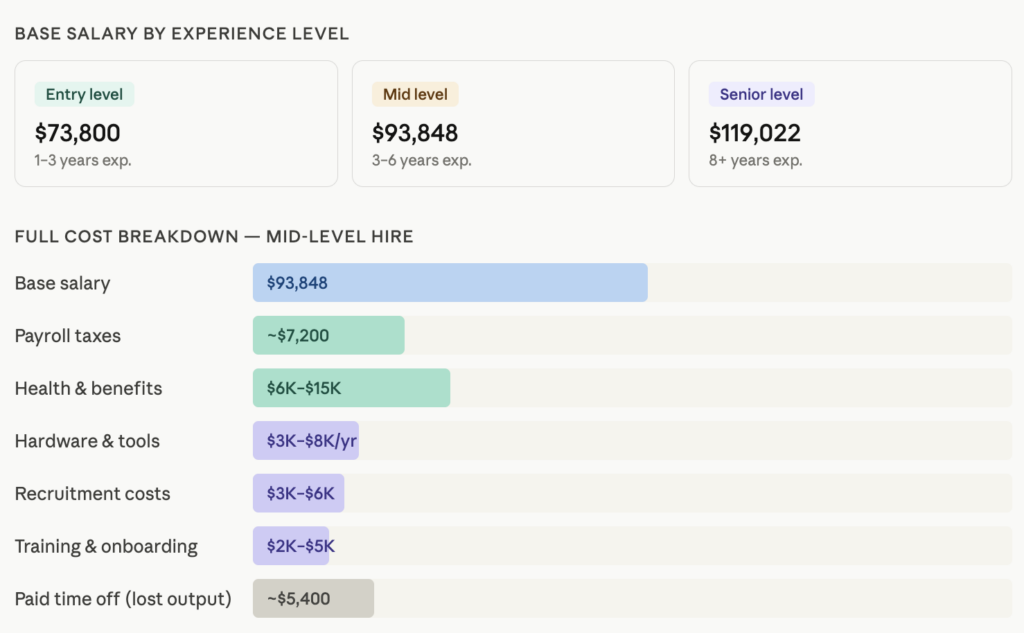
The average salary for a web developer in the United States is $100,550 per year as of 2026, with a typical pay range of $77,191 to $132,166, depending on experience, location, and specialization.
An entry-level web developer with one to three years of experience earns an average of around $73,800, while a senior-level developer with eight or more years of experience commands an average of $119,022.
The True Total Cost
Salary is only one part of what you actually pay. When you hire a full-time employee, the real cost of employment is considerably higher than the number on the offer letter. Here is what businesses consistently underestimate:
- Employer payroll taxes: Typically, 7.65% of base salary on top of what the employee receives
- Health insurance and benefits: Can add $6,000 to $15,000 per year per employee, depending on plan and location
- Paid time off, sick leave, and holidays: Roughly 15 to 20 paid days per year that you are paying for without output
- Hardware and software: A capable developer workstation, licensed development tools, staging environments, and software subscriptions can run $3,000 to $8,000 upfront and several thousand per year ongoing
- Recruitment costs: Job board listings, recruiter fees if you use one, interview time, and HR overhead add up quickly
- Onboarding and training: Traditional in-house recruitment takes 45 to 90 days before a developer even starts, and new hires still need ramp-up time to understand your systems and workflows before becoming fully productive
When you add it all up, annual in-house costs for US-based developers can realistically range from $160,000 to $280,000 or more, including the full cost of employment beyond base salary.
That number does not make hiring in-house wrong. It makes it a serious decision that deserves serious analysis.
The Real Benefits of Hiring an In-House Web Developer
When the fit is right, and the business need is genuine, an in-house web developer delivers advantages that no freelancer or agency can fully replicate.
Deep Understanding of Your Business
An in-house developer immerses themselves in your brand, your systems, and your goals every single day. They learn your tech stack, your audience, your team’s working style, and the specific quirks of your website. Over time, that institutional knowledge becomes genuinely valuable. An in-house developer will have a better understanding of your company’s culture, goals, and needs, and can work within that culture to collaborate more effectively with internal team members and departments.
Faster Response Time and Real Availability
When your checkout page goes down at peak traffic hours or a campaign landing page breaks the night before a launch, having someone in-house who can respond immediately is worth a great deal. You are not waiting for a ticket to be picked up or a freelancer to check their messages. With an in-house developer, you do not need to worry about project continuity when a contract ends because they are full-time hires who remain present throughout the full lifecycle of your platform.
Seamless Collaboration with Internal Teams
Web development does not happen in a vacuum. Marketing needs new landing pages. Sales wants a form updated. The product team has a feature request. An in-house developer sits in on all these conversations and can act on them without the back-and-forth coordination required with external partners. They attend your meetings, understand your campaigns, and align their work with your business rhythm in a way an outsourced team rarely does as naturally.
Consistent Quality and Security Standards
Every project your in-house developer touches follows the same coding standards, design system, and security protocols. There is no handoff between contractors with different working styles, no inconsistency between how one freelancer built a feature and how another one needs to extend it. For businesses where security compliance and code quality matter, that consistency has real long-term value.
Cost Savings Over Time for High-Volume Work
If your business genuinely has continuous, ongoing development needs, the math can eventually favor in-house hiring over repeated agency retainers or escalating freelancer invoices. The crossover point depends on volume, but businesses that are constantly building, iterating, and maintaining a complex web presence often find that a dedicated in-house resource pays for itself across a multi-year horizon.
In-House Web Developer: The Real Downsides You Need to Weigh Carefully
In-house hiring has genuine advantages, but it also comes with limitations that businesses often discover only after committing to the hire.
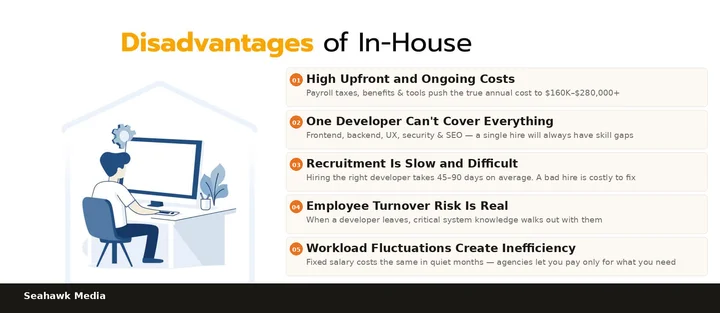
High Upfront and Ongoing Costs
As covered above, the fully loaded cost of an in-house developer is substantial. For small businesses or those with intermittent development needs, paying a full-time salary for work that only materializes a few times a month is an expensive arrangement. You may pay a premium salary to fill a web developer position only to find the bulk of the work involves updating content or off-topic marketing activities, and that role eventually consumes 100% of the employee’s time, while you still need to outsource specialized development work.
One Developer Cannot Cover Everything
Web development is not a single skill. It spans frontend development, backend architecture, UI and UX design, database management, security, performance optimization, SEO technical implementation, and more. An in-house developer will rarely have the range of knowledge you can find with a full-service agency team, and you will likely need at least two people to cover the breadth of skills a full-service agency brings.
A single in-house hire will inevitably have gaps. Those gaps mean either accepting lower quality in certain areas, paying for additional contractors to fill them, or overloading your developer with responsibilities outside their core competency.
Recruitment is Slow and Difficult
Finding, screening, and hiring the right developer is a huge hassle, particularly in the technology industry, and not every business owner has the time to go through the process, especially when their internal HR team already has plenty of other responsibilities. A bad hire in a technical role is also significantly more costly to undo than in most other positions, given the time investment in onboarding and the knowledge that leaves when someone leaves.
Employee Turnover Risk is Real
When your in-house developer leaves, they take everything they know about your systems with them. Documentation helps, but it never captures everything. In-house teams also face scalability limitations since sudden upscaling is not easy, whereas outsourced teams can scale rapidly as project needs evolve. Replacing a developer mid-project creates delays, rework, and costs that businesses rarely budget for in advance.
Workload Fluctuations Create Inefficiency
Most businesses do not have a perfectly consistent pipeline of development work throughout the year. There are busy seasons and quiet seasons. An in-house developer on a fixed salary costs the same in both cases. With an agency or freelancer, you pay for what you actually need, when you actually need it.
Need a Reliable WordPress Development Partner?
Seahawk Media builds, manages, and maintains WordPress websites so you get the depth of a full team without the overhead of a full-time hire. Plans start at $129 for one hour!
What Are the Alternatives to Hiring In-House?
If in-house hiring does not fit your business right now, you have several strong alternatives worth evaluating seriously.
Freelance Web Developers
Freelancers offer flexibility, lower hourly costs for short engagements, and access to specialists for specific technologies or project types. Freelancers are great for quick projects, while in-house developers provide reliable ongoing work.
The tradeoff is accountability and continuity. Freelancers are sometimes less committed to a project and have lower accountability, and there is a greater chance they might become unavailable mid-project. They also pose security risks because they require access to your systems and data, and their involvement ends when the contract does.
Freelancers work best for defined, scoped projects with clear deliverables and timelines. They are less suited for ongoing maintenance, emergency support, or deeply integrated work that requires understanding your full stack.
Web Development Agencies
Agencies give you access to an entire team: frontend developers, backend engineers, designers, project managers, and in many cases, SEO and performance specialists, all under one roof. Agencies are an excellent choice for businesses whose development needs fluctuate, as they can ramp up or down as needed and also shoulder post-launch responsibilities such as website maintenance, emergency support, content updates, and search engine optimization.
The cost is higher than that of a freelancer for small tasks, but the breadth of capability and accountability structure is significantly stronger. Agencies also stay current with technology trends because they are actively working across multiple projects and industries simultaneously.
Outsourced or Offshore Development Teams
Outsource dedicated teams in Southeast Asia and India averages $25 to $60 per hour compared to $80 to $180 per hour for US-based in-house developers, with no obvious quality difference at the senior level, and the savings increase further when you factor in zero recruitment fees, no benefits overhead, and shorter placement timelines.
Offshore teams work well for product companies with large development backlogs and clear technical specifications. They require more structured communication and project management on your end, but the cost savings are substantial enough that many businesses use offshore teams specifically for development work while keeping strategy and marketing in-house.
The Hybrid Model
Many growing businesses adopt a hybrid approach: a lean internal team or a single point of contact who understands the business and manages relationships, combined with an external agency or development partner that handles the actual build work. Combining in-house resources with external expertise allows you to tap into your internal team’s familiarity with your company goals while external experts bring fresh perspectives, specialized skills, and up-to-date knowledge of the latest trends and technologies.
This model gives you the responsiveness and brand knowledge of an internal hire without the cost and limitations of trying to make one person cover every technical need.
Which Option is Actually Right for Your Business?
There is no universal answer here, but there are some clear signals that point in one direction or another.
Hire in-house if:
- Your website is the core of your revenue model and requires daily active development
- You have consistent, high-volume work that justifies a full-time salary year-round
- Your business handles sensitive customer data and requires tight internal security control
- You have the budget to cover the full cost of employment without it straining operations
- You have previously worked with freelancers or agencies and found the coordination overhead too costly
Work with a freelancer if:
- You have a specific, time-bound project with clear requirements
- Your ongoing maintenance needs are light and predictable
- You need a specialist skill for one piece of a larger project
Partner with an agency if:
- You need a full team across multiple disciplines without managing individual hires
- Your development needs fluctuate significantly throughout the year
- You want ongoing support, maintenance, SEO, and performance optimization under one relationship
- You are building something complex and cannot afford the risk of a single hire covering everything
Consider a hybrid if:
- You want an internal presence but need more capacity than one person can provide
- You are scaling quickly and need flexibility to expand or contract development resources rapidly
How Seahawk Media Fits into This Decision?
At Seahawk Media, we work with businesses at every stage of this decision. Some come to us after a bad in-house hire. Some come because their freelancer disappeared mid-project. Most come because they need a reliable partner who can take full ownership of their web presence without the overhead and risk of building an internal team from scratch.
Our WordPress development and web management services give you the benefits of an experienced, dedicated team without the recruitment costs, salary overhead, or turnover risk that come with hiring in-house. We handle builds, maintenance, performance optimization, security, and ongoing improvements so your website continues to be a growth asset for your business.
If you are weighing up your options and want a straight conversation about what makes sense for your specific situation, reach out to the Seahawk Media team today.
What Business Owners and Experts Actually Think About Hiring In-House?
This decision generates strong opinions across the business and development communities, and the consensus is more nuanced than a simple yes-or-no. Here is what founders, developers, and agency leaders consistently say when asked whether hiring in-house is the right move.
“Most Founders Pick Wrong Because of Timing, Not Budget”
The most honest perspective from experienced founders is that in-house hiring makes the most sense when software is your core business, and you can invest for the long term. The recommendation is to start with an agency or studio and transition to in-house only when the product has proven traction. The goal should not be to optimize for the cheapest option, but rather to find the fastest path to a working product with the lowest risk of failure.
This is one of the most repeated patterns in founder communities. Businesses hire in-house too early, lock themselves into high fixed costs before they have enough consistent work to justify them, and then scramble to course-correct. The timing of the hire matters as much as the hire itself.
“Hiring the Wrong Team Cost Me an Entire Year”
One founder on Product Hunt put it plainly after a painful 2022 experience: they spent a full year trying to build a product with a team that kept asking for more time and more money without delivering. The lesson they shared publicly was direct: take your time to hire the right team, do your research before committing, and do not let urgency or optimism push you past the due diligence that protects your business.
This is not an isolated story. The pattern repeats across founders at different stages: delays from an in-house team that was not ready yet, a fragmented product built by freelancers without structure, or an agency that delivered code but not a working product. What businesses actually need at that decision point is not just development but clarity, direction, and a team that can take ownership from idea to execution without constant back-and-forth.
“The Question is Really About Continuity, Not Cost”
Among design and development leaders working with early-stage companies, the consistent observation is that choosing between an in-house hire, a freelancer, and an agency is less about cost and more about continuity. A fragmented development layer eventually slows growth, and inconsistent output reduces trust both internally and with customers.
The businesses that struggle most are those that optimize for the cheapest option at each stage, without considering what happens after the project ends. Websites are never finished. Security updates, bug fixes, and improvements are ongoing. Agencies and in-house teams handle this naturally, but freelancers may simply not be available once the contract closes.
“In-House Works When the Work is Actually Ongoing”
Experienced hiring advisors consistently point out that in-house hiring makes the most sense when you need long-term consistency, deep company knowledge, and alignment with your culture and goals. For a SaaS business that constantly ships product updates, having an in-house developer ensures continuity and focus. In-house employees are more accountable, operate within your schedule, attend your meetings, and are fully available to your company in a way that is genuinely hard to replicate with freelancers or agencies.
The critical qualifier in that statement is ongoing work. If your development needs are project-based or seasonal, the math does not support a full-time hire, no matter how appealing the idea of internal availability sounds.
“Agencies Can Ramp Up When You Cannot.”
A perspective that comes up repeatedly among technical founders is that agencies are built to absorb complexity in a way that a single in-house hire simply cannot. What starts as a simple website often grows into payments, user accounts, integrations, and ongoing updates. Freelancers will struggle as the scope grows beyond their individual capacity, in-house teams take too long to form at scale, and agencies are specifically built to handle that kind of expanding complexity without the business owner needing to manage the growth of the development function itself.
The Bottom Line from People Who Have Been There
The businesses that navigate this decision well tend to share a few common traits. They are honest about how much consistent development work they actually have. They factor in the full cost of employment rather than just the salary line. They think about what happens when someone leaves or a project scope changes unexpectedly. And they choose the model that matches where their business is right now, not where they hope it will be in two years.
The most experienced voices on this topic agree that in-house teams deliver long-term value through deep product knowledge and cultural alignment, but many successful products use hybrid approaches that combine models to optimize outcomes. The choice can and should evolve as the product and business grow.
Frequently Asked Questions
How much does it cost to hire an in-house web developer in 2026?
The typical base salary for a web developer in the US in 2026 sits in the low to mid $90,000s, with total compensation including bonuses and equity often exceeding $110,000 for full-time roles. When you add benefits, hardware, software, training, and recruitment costs, the fully loaded annual cost can realistically range from $160,000 to $280,000 or more, depending on the hire’s seniority and location.
When does hiring in-house make more sense than using an agency?
Hiring in-house makes more sense when you have consistent, ongoing development needs that justify a full-time salary, your website is mission-critical to daily revenue, and you need immediate availability and deep institutional knowledge rather than project-based support.
What is the biggest risk of hiring an in-house developer?
Employee turnover is one of the most underestimated risks. When an in-house developer leaves, they take system knowledge, undocumented decisions, and project context with them. Finding and onboarding a replacement takes time and money, and the gap period creates real operational risk for businesses that depend heavily on their website.
Can a single in-house developer handle everything a business needs?
Rarely. Web development covers frontend, backend, security, performance, UX design, and more. An in-house developer will rarely have the breadth of knowledge found in a full-service agency team, and most businesses need at least two people to adequately cover the skills required. A single hire will always have gaps that either limit capability or require additional outsourcing.
What is a hybrid development model?
A hybrid model combines an internal resource who manages relationships, understands the business, and handles day-to-day coordination with an external agency or development partner who handles the actual technical build work. It gives businesses the responsiveness of an in-house presence alongside the depth and scalability of an external team.
How long does it take to hire an in-house web developer?
Traditional in-house recruitment typically takes 45 to 90 days from posting to hire, and new developers still need additional ramp-up time to understand your codebase, systems, and workflows before contributing at full capacity. For businesses with urgent needs, an agency or pre-vetted development partner can often start within days.