WordPress powers millions of websites and relies heavily on authenticated admin actions, which makes it an attractive target for CSRF attacks.
Cross-Site Request Forgery is a web security vulnerability that tricks a logged-in user into performing unintended actions on a website without their knowledge. In the context of WordPress, attackers exploit authenticated sessions to trigger actions such as changing settings, creating users, or modifying content.
Fortunately, several proven defenses can significantly reduce this risk. This guide covers the key protections, including implementing CSRF tokens, configuring SameSite cookies, securing AJAX requests, and regularly testing your site to ensure these safeguards remain effective.
TL:DR: Quick Checklist to Protect Your Website
- Cross-Site Request Forgery tricks a logged-in user’s browser into performing unauthorized actions on a website.
- Sites built on WordPress are common targets due to authenticated admin sessions, plugins, and custom endpoints.
- Common vulnerabilities include missing CSRF tokens, insecure AJAX endpoints, and poorly configured cookies.
- Strong defenses include WordPress nonces, anti-CSRF tokens, secure request headers, and SameSite cookie settings.
- Regular security scans, plugin audits, and manual testing help detect vulnerabilities early.
- Professional WordPress security audits can help identify risks and implement effective long-term protection.
Why CSRF Attacks Matter for WordPress?
Cross-Site Request Forgery attacks pose a serious security risk for websites built on WordPress.
Because WordPress relies heavily on authenticated user sessions, especially for administrators and editors, attackers can exploit these sessions to perform unauthorized actions.
Instead of stealing login credentials, CSRF tricks a logged-in user’s browser into sending malicious requests to the site. If proper protections are not in place, these requests can execute critical changes in the background without the user realizing it.
Exploiting Authenticated Browser Sessions
CSRF attacks exploit an active login session. When a logged-in user visits a malicious page, the attacker can trigger requests to the WordPress site using the user’s existing authentication cookies.
As a result, the website treats the request as legitimate, allowing the attacker to perform actions such as updating settings or modifying content.
Vulnerable Plugins and Custom Endpoints
Many WordPress websites rely on third-party plugins, custom themes, or API endpoints. If these components fail to implement CSRF protection mechanisms, they expand the attack surface.
This risk is especially significant for agency-managed and enterprise WordPress environments where multiple integrations and custom features are common.
Unauthorized Changes Without Data Theft
Unlike other attacks, CSRF does not necessarily steal data from the site. Instead, it performs unauthorized actions, such as creating new administrator accounts, altering configuration settings, or injecting malicious scripts, while the legitimate user remains unaware.
How a CSRF Attack Works on WordPress?
A Cross-Site Request Forgery (CSRF) attack manipulates a trusted user’s browser to perform unintended actions on a website.
On platforms like WordPress, this happens when the application cannot distinguish between legitimate user actions and forged requests.
Because the browser automatically sends authentication cookies with each request, attackers can exploit an active login session to execute privileged operations without the user’s awareness.
- Luring the User to a Malicious Page: The attacker first tricks a logged-in user into visiting a malicious webpage. This page may contain hidden forms or scripts designed to submit requests to the target WordPress site.
- Automatic Cookie-Based Authentication: When the forged request is triggered, the browser automatically includes the user’s session cookies. As a result, the WordPress server processes the request as if it were initiated by the authenticated user.
- CSRF in Single-Page Applications: Modern single-page applications can also be vulnerable. If tokens are exposed or malicious scripts run in the browser, attackers can trigger unauthorized AJAX requests that perform actions on behalf of the user.
Common CSRF Vulnerabilities in WordPress
Cross-Site Request Forgery vulnerabilities typically appear when applications fail to verify whether a request truly originated from a trusted user action.
In WordPress websites, these weaknesses often arise from poorly secured forms, plugins, REST endpoints, or AJAX handlers.
As such, understanding the most common CSRF vulnerabilities helps site owners and developers implement stronger security controls.
- State-Changing Actions via GET Requests: When critical actions, such as updating settings or deleting data, are exposed via GET requests, they become easy targets for CSRF. Attackers can embed these requests in elements like image tags or hidden links, automatically triggering actions when a logged-in user visits a malicious page.
- Missing or Incorrect CSRF Tokens: Forms and REST API endpoints that lack proper CSRF tokens fail to verify request authenticity. Without token validation, the server cannot confirm whether the request came from a legitimate user interaction, allowing attackers to forge requests.
- Misconfigured Cross-Origin Controls: Overly permissive CORS policies or missing Fetch Metadata protections can enable cross-origin requests from malicious sites. This misconfiguration increases the likelihood of CSRF exploitation.
- Insecure AJAX Endpoints: AJAX handlers that accept requests without verifying tokens or custom security headers expose sensitive functionality. Attackers can easily send forged requests to these endpoints.
- Weak Plugin Security Practices: Plugins that skip nonce verification or reuse static tokens introduce predictable vulnerabilities, making them a common entry point for CSRF attacks.
Seahawk Media Website Care and WordPress Security
Protecting WordPress websites from vulnerabilities requires proactive monitoring, secure development practices, and continuous security audits. Seahawk Media offers comprehensive website care and security services designed to safeguard sites built on WordPress.

From routine maintenance to emergency recovery, our solutions help businesses and agencies reduce security risks while ensuring site stability and performance.
Managed Website Maintenance
We provide ongoing maintenance that includes regular plugin and theme audits to identify vulnerabilities. Our team also verifies nonce implementation, ensures proper CSRF token usage, and configures SameSite cookies to reduce the risk of cross-site request exploitation.
Hacked Site Repair and Recovery
If a site is compromised, our security specialists conduct a detailed forensic analysis to determine the source of the attack. The recovery process includes removing malicious code, rotating compromised tokens, strengthening authentication mechanisms, and hardening vulnerable endpoints to prevent future attacks.
White-Label Security Services for Agencies
Agencies managing multiple WordPress sites can leverage Seahawk’s white-label security solutions. These services include CSRF protection implementation, API and endpoint security audits, and scheduled vulnerability scans to maintain a strong security posture across client websites.
We also offer a free consultation to evaluate potential CSRF vulnerabilities. Plus, recommend practical remediation steps tailored to each WordPress environment.
Secure Your WordPress Site Before the Next Hack
Protect your site with expert security checks, vulnerability fixes, and proactive monitoring. Identify risks early and keep your site, users, and data safe.
CSRF Protection: Core Principles and Security Tips
Protecting a WordPress site from CSRF requires a combination of secure coding practices, proper request validation, and strict browser-level protections.
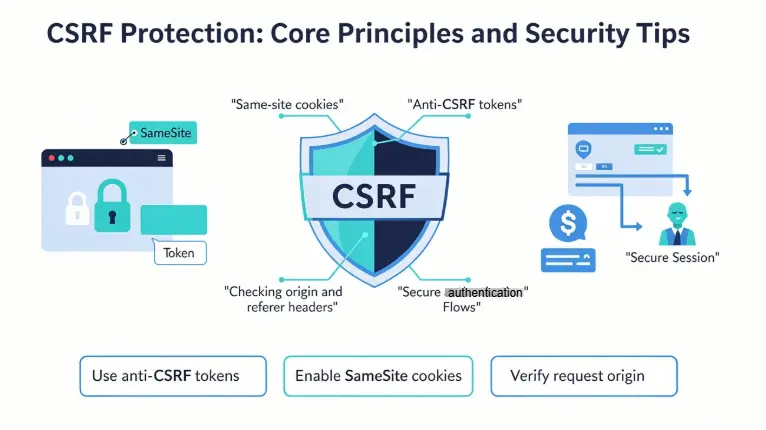
The following principles outline the most actionable strategies developers and site owners should follow to safeguard WordPress environments.
Tip 1: Use CSRF Tokens And WordPress Nonces (Anti-CSRF Token)
One of the most reliable methods for preventing CSRF attacks is the use of anti-CSRF tokens.
These tokens are unique, unpredictable values generated by the server and embedded within forms or requests. When the request is submitted, the server validates the token to confirm that it originated from the legitimate application.
- In WordPress, this mechanism is implemented through nonces, which are security tokens designed to verify intent.
- Developers can generate nonces using functions like
wp_create_nonce()and validate them withwp_verify_nonce().
- These tokens are typically added to forms or URLs that trigger sensitive actions such as updating settings, deleting posts, or managing users.
Because each nonce is time-limited and tied to a specific action, attackers cannot easily forge valid requests from external sites.
Even if a malicious page attempts to submit a form automatically, the request will fail if the token is missing or invalid. Proper nonce verification should therefore be implemented across admin forms, plugin settings pages, and custom workflows that modify data.
Tip 2: Protect AJAX Requests, REST API, and Custom Endpoints
Modern WordPress websites frequently rely on AJAX calls, REST APIs, and custom endpoints to perform asynchronous operations. These endpoints can become attractive targets for CSRF attacks if request verification is not properly implemented.
- AJAX requests should always include a nonce or security token that is validated on the server before processing the request.
- WordPress developers commonly pass this nonce through localized scripts using wp_localize_script() and then send it as part of the AJAX payload.
- On the server side, the request can be validated with check_ajax_referer().
In addition to tokens, developers should consider enforcing custom request headers.
By requiring specific headers in AJAX requests, the application can ensure that requests originate from trusted scripts rather than external websites. This approach provides an additional validation layer that complements token verification.
Custom REST API endpoints should also verify permissions using callbacks and nonce validation. Without these protections, attackers could craft requests that perform unauthorized actions through exposed endpoints.
Tip 3: Double-Submit Cookies and Token Patterns (Anti-CSRF Tokens)
Another effective CSRF defense mechanism is the double-submit cookie pattern.
- In this approach, a CSRF token is stored in both a browser cookie and a request parameter (such as a form field or header). When the request reaches the server, both values must match for the request to be considered valid.
- This method works because attackers from external domains cannot access or read the victim’s cookies due to browser security restrictions. As a result, they cannot generate a valid token pair that satisfies server validation.
Although WordPress primarily relies on nonce-based protection, the double-submit pattern can be useful in custom authentication flows, headless WordPress setups, or applications that integrate with external front-end frameworks.
When implemented correctly, this pattern provides an additional safeguard against forged cross-site requests.
Developers should ensure that tokens are cryptographically random, regenerated periodically, and invalidated after use where appropriate. Predictable or static tokens weaken security and increase the likelihood of successful attacks.
Tip 4: SameSite, Secure, and HttpOnly Cookie Settings (Cross-Site/CSRF Protection)
Cookie configuration plays a crucial role in defending against CSRF attacks.
Browsers automatically include cookies with requests sent to a domain. This is exactly what attackers rely on when exploiting authenticated sessions. Proper cookie attributes help restrict when and how cookies are transmitted.
- The SameSite cookie attribute prevents browsers from sending cookies along with cross-site requests in certain situations. When configured with SameSite=Lax or SameSite=Strict, cookies are not included in many cross-origin request scenarios, reducing the likelihood of successful CSRF attempts.
- The Secure attribute ensures that cookies are only transmitted over HTTPS connections. This prevents session cookies from being exposed through unencrypted network traffic.
- The HttpOnly attribute blocks client-side scripts from accessing cookies via JavaScript. Although this primarily protects against cross-site scripting (XSS), it also strengthens session security overall.
Together, these attributes form an essential layer of browser-level defense that complements server-side token validation.
Tip 5: Avoid Ineffective CSRF Mitigations (Common CSRF Vulnerabilities)
Many developers attempt to mitigate CSRF risks using techniques that provide little or no real protection. Understanding these ineffective methods helps avoid common security mistakes.
For example, relying solely on HTTP Referer headers is unreliable because they may be absent or manipulated in certain scenarios. Similarly, restricting requests based only on user-agent strings does not prevent forged requests from external sites.
Another common mistake is exposing state-changing operations through GET requests. Because GET requests can be triggered by simple elements such as images or links, sensitive actions should always require POST requests with proper token validation.
Finally, plugins or custom code that skip nonce verification or reuse static tokens create predictable vulnerabilities. Regular security reviews and plugin audits help ensure that these weaknesses are identified and corrected before attackers can exploit them.
By implementing these core principles and avoiding weak mitigation strategies, WordPress site owners can build a much stronger defense against CSRF attacks and protect both administrative functionality and user data.
Detecting and Testing CSRF Vulnerabilities
Identifying Cross-Site Request Forgery vulnerabilities requires both automated scanning and manual security testing. Because sites built on WordPress often rely on plugins, REST APIs, and AJAX handlers, security testing must cover all endpoints that perform state-changing actions.
A structured testing approach helps confirm whether proper CSRF protections, such as tokens, nonce validation, and request verification, are correctly implemented.
- Use Automated Security Scanners: Automated security scanners can detect potential CSRF weaknesses by analyzing forms, REST routes, and plugin endpoints. Many WordPress-focused scanners include tests that identify missing token validation or improperly protected requests.
- Manually Test Sensitive Endpoints: Manual testing helps validate how the server handles forged requests. Security testers can remove or modify CSRF tokens in requests to verify that the application rejects unauthorized actions.
- Review JavaScript and AJAX Implementations: Inspect front-end scripts to ensure tokens are securely generated, retrieved, and transmitted in AJAX request headers or parameters.
- Audit Plugin and Endpoint Code: Review plugin code for missing nonce verification and insecure handling of admin-ajax.php or custom endpoints that process sensitive actions.
Responding to a CSRF Compromise
When a Cross-Site Request Forgery attack succeeds, it can trigger unauthorized changes or inject malicious code into a website. For sites built on WordPress, a quick and structured response is essential to limit damage and restore security.
Immediate containment, code cleanup, and vulnerability patching help prevent attackers from maintaining access or repeating the exploit.
- Revoke Sessions and Rotate Tokens: Immediately log out all active sessions, rotate CSRF tokens, and require password resets for affected accounts to stop further unauthorized actions.
- Remove Malicious Code: Scan themes, plugins, and the uploads directory for injected malicious scripts or backdoors, and remove any compromised files.
- Patch Vulnerable Components: Fix the vulnerable plugin or custom code responsible for the exploit and implement proper token and header validation.
- Review Server Logs: Analyze server logs to identify exploited endpoints and determine the timeline of unauthorized actions.
Checklist: WordPress CSRF Hardening Best Practices
Strengthening protection against Cross-Site Request Forgery requires consistent security checks across forms, APIs, cookies, and third-party components.
For websites running on WordPress, implementing a structured CSRF hardening checklist helps ensure that every request performing sensitive actions is properly verified.
Regular audits and testing further reduce the risk of attackers exploiting overlooked vulnerabilities.
- Validate CSRF Tokens: Ensure every state-changing form, API request, or endpoint validates a per-session or per-request CSRF token before executing any action.
- Secure AJAX Requests: Require custom request headers for AJAX requests and verify them server-side before processing the request.
- Configure Secure Cookies: Set session cookies with Secure, HttpOnly, and appropriate SameSite attributes to limit cross-site request exposure.
- Audit Plugins and Themes: Regularly review and update third-party plugins and themes to confirm nonce and token verification are in place.
- Perform Regular Security Testing: Run automated scans and manual tests frequently, focusing on REST routes, AJAX handlers, and custom endpoints.
To Sum Up
Protecting your website from Cross-Site Request Forgery is essential for maintaining the integrity of user actions and administrative controls. On platforms like WordPress, even a small CSRF vulnerability can allow attackers to change settings, create unauthorized users, or inject malicious code.
Implementing strong defenses, as CSRF tokens, secure cookie configurations, and hardened endpoints, can significantly reduce these risks. However, identifying and fixing vulnerabilities across plugins, themes, and custom code often requires specialized expertise.
If you want complete assurance that your site is secure, consider hiring experienced WordPress security professionals. They will audit your site, patch vulnerabilities, and implement long-term protection.
FAQs on WordPress CSRF Attacks
What is Cross-Site Request Forgery (CSRF)?
Cross-site request forgery occurs when an attacker tricks a normal user into visiting a malicious website or clicking a malicious link.
The user’s web browser then sends requests to the target site using the user’s session ID or session token. Since the browser sends authentication cookies automatically, the web server may treat the request as a legitimate request and process state-changing HTTP requests, such as a form submission.
How do CSRF protection mechanisms work?
CSRF protection mechanisms rely on token generation and validation. Using the synchronizer token pattern, the web app creates a session token stored in the session identifier.
When a user submits an HTML form, the request includes the correct token in a hidden form field, allowing the web server to accept POST requests safely.
Why are SameSite cookies and custom headers useful?
SameSite cookies restrict when the browser sends cookies across a particular origin. Combined with a custom header for AJAX requests, they help prevent CSRF vulnerabilities in modern web frameworks.
How can developers prevent potential CSRF attacks?
Developers should protect forms, validate tokens, avoid token reuse, monitor user logs, and enforce user authentication across the web application.